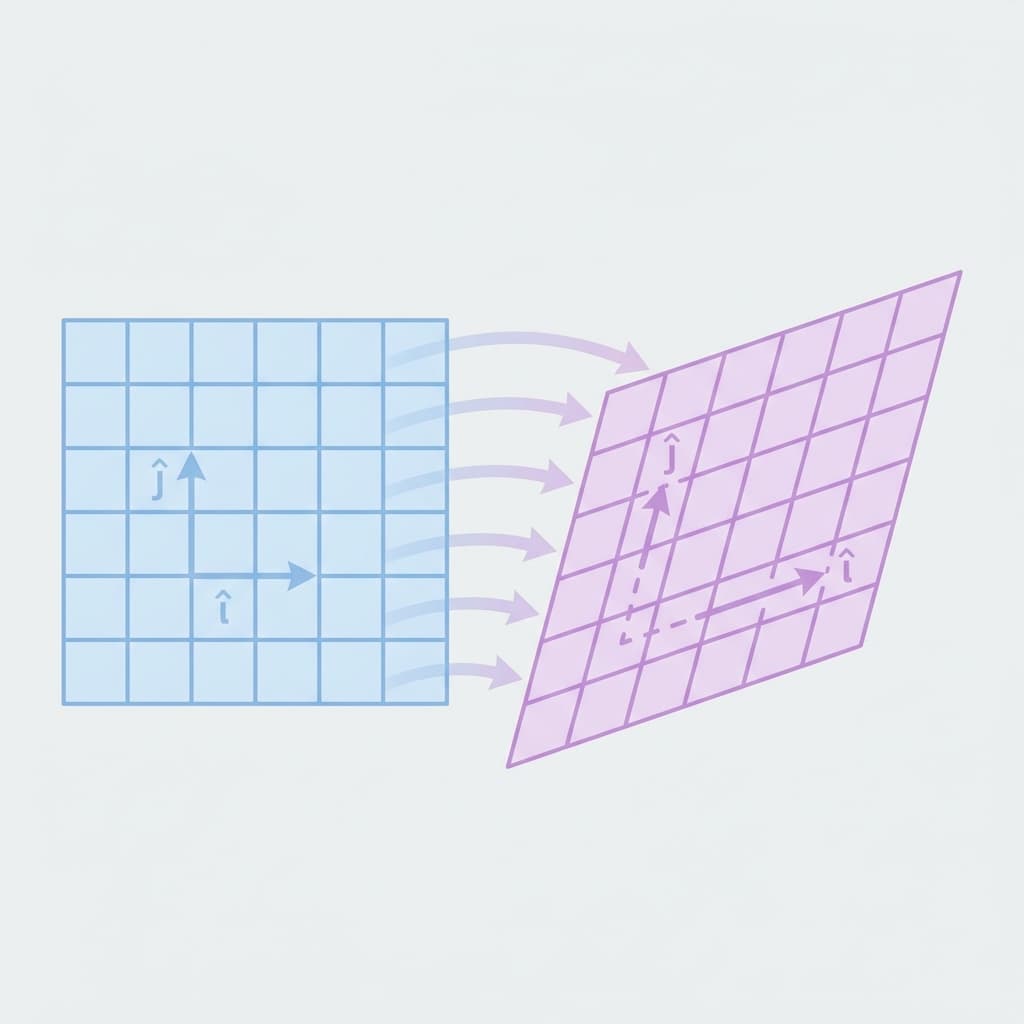
We've learned about vectors and basis vectors. Now let's see how space itself can move.
What is a Transformation?
A transformation takes a vector as input and outputs another vector.
Think of it as a function for vectors. You put one in, you get another out.
Visualizing Transformations
Imagine every point in space moving to a new location. The entire plane squishes, stretches, or rotates.
That's what a transformation looks like.
Linear Transformations
Not all transformations are "linear." A transformation is linear if:
- All lines stay straight - No curving allowed
- The origin stays fixed - (0, 0) doesn't move
What This Looks Like
Grid lines stay parallel and evenly spaced. They might rotate, stretch, or shear. But they never curve or break.
A rotation is linear. A stretch is linear. But bending or warping is not.
The Key Insight
Here's the magic: A linear transformation is completely determined by where the basis vectors land.
If you know where î and ĵ end up, you know where every vector ends up.
Why?
Any vector is a linear combination of î and ĵ.
v = -1 × î + 2 × ĵAfter a transformation, the vector becomes the same combination of the new basis vectors.
transformed v = -1 × (new î) + 2 × (new ĵ)Track two vectors, predict all vectors.
Matrices
This is where matrices come in.
A 2D linear transformation needs just four numbers:
- Where î lands (2 numbers)
- Where ĵ lands (2 numbers)
We package these into a 2×2 matrix:
[ a  c ]
[ b d ]- First column = where î lands = [a, b]
- Second column = where ĵ lands = [c, d]
A matrix is just a way to describe a linear transformation.
Matrix-Vector Multiplication
To transform a vector, we compute:
[ a  c ]   [ x ]   [ ax + cy ]
[ b  d ] × [ y ] = [ bx + dy ]
This is just calculating:
x × (new î) + y × (new ĵ)The matrix tells us the new basis vectors. The input vector tells us how to combine them.
Examples
90° Counterclockwise Rotation
Where do the basis vectors go?
- î (pointing right) → rotates to point up →
[0, 1] - ĵ (pointing up) → rotates to point left →
[-1, 0]
Matrix:
[  0  -1 ]
[  1   0 ]
Shear
A shear keeps î fixed but tilts ĵ.
- î stays at
[1, 0] - ĵ moves to
[1, 1]
Matrix:
[ 1  1 ]
[ 0  1 ]
This slants everything to the right. Like italicizing text.
Horizontal Stretch
Double the width, keep the height.
- î goes to
[2, 0] - ĵ stays at
[0, 1]
Matrix:
[ 2  0 ]
[ 0  1 ]
Reading a Matrix
Given any matrix, you can visualize the transformation:
- Look at the first column - that's where î lands
- Look at the second column - that's where ĵ lands
- Imagine the grid moving accordingly
When Columns Are Linearly Dependent
If the two columns point in the same direction, the transformation squishes 2D space onto a line.
All of 2D collapses to 1D. Information is lost.
Why This Matters
Understanding matrices as transformations unlocks everything else:
- Matrix multiplication = combining transformations
- Determinants = how much area changes
- Eigenvalues = what stays in place
Matrices aren't just grids of numbers. They're actions that move space.
Key Takeaways
- Transformation = Function that moves vectors
- Linear transformation = Lines stay straight, origin stays fixed
- Matrix = Description of a linear transformation
- Columns = Where the basis vectors land
- Matrix multiplication = Apply the transformation to a vector