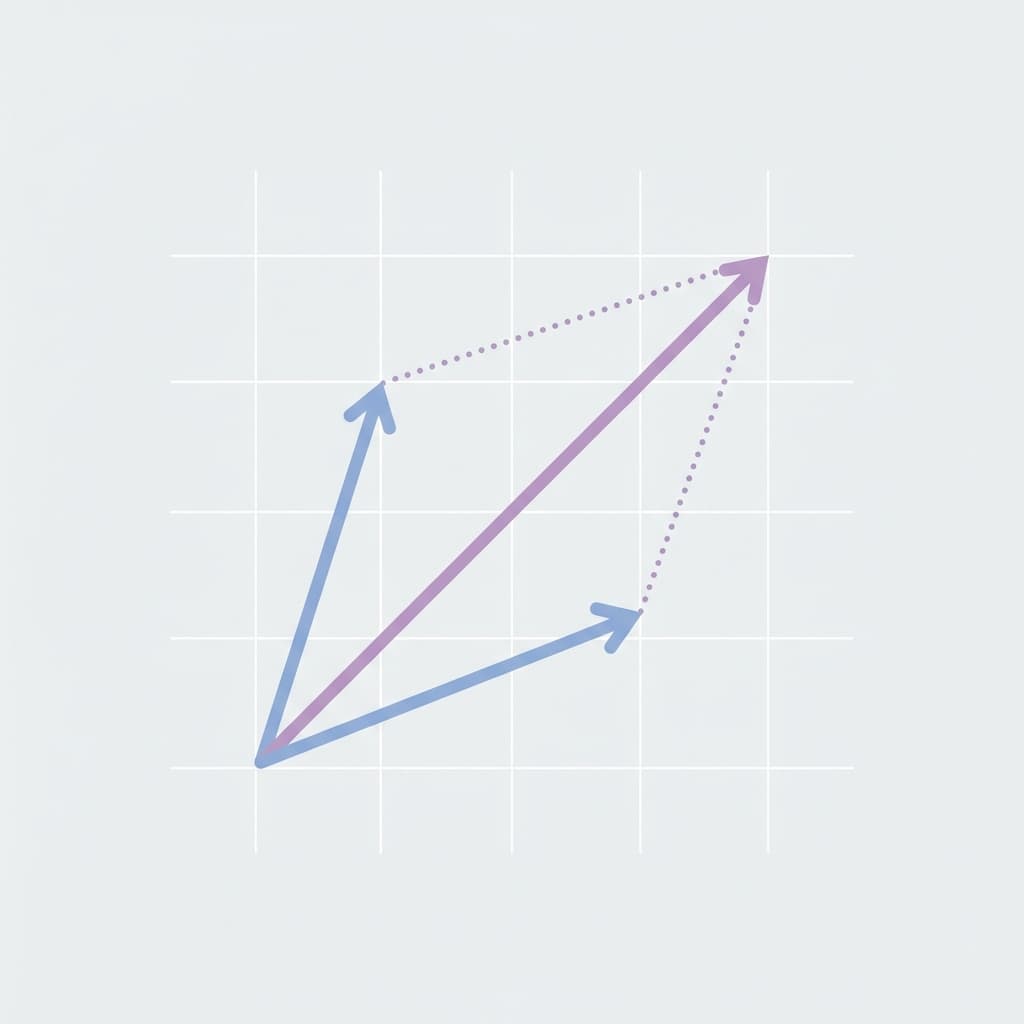
In the last post, we learned what vectors are. Now let's see how they combine and what that means.
Basis Vectors
Remember coordinates like [3, 2]? Those numbers are actually scalars that stretch special vectors.
Meet î and ĵ
i-hat (î)
A unit vector pointing right along the x-axis: [1, 0]
j-hat (ĵ)
A unit vector pointing up along the y-axis: [0, 1]
These are the basis vectors of our standard coordinate system.
What Coordinates Really Mean
When you see [3, 2], it means:
3 × î + 2 × ĵ- Take î, stretch it by 3
- Take ĵ, stretch it by 2
- Add them together
The result lands at point (3, 2).
Every vector is just a sum of scaled basis vectors.
Different Basis, Different Coordinates
Here's the key insight: basis vectors are a choice.
You could pick two completely different vectors as your basis. The same point in space would then have different coordinates.
When someone gives you coordinates, they're implicitly using a specific basis. Usually, it's î and ĵ.
Linear Combinations
A linear combination is what you get when you:
- Scale some vectors (multiply by numbers)
- Add them together
Example:
2 × v + 3 × wThis is a linear combination of vectors v and w.
Why "Linear"?
Fix one scalar, vary the other. The tip of the resulting vector traces a straight line.
That's the "linear" in linear combination.
Span
The span of a set of vectors is all the possible vectors you can reach using their linear combinations.
Think of it as: "What can these vectors create together?"
Span in 2D
Two random vectors
Their span is usually the entire 2D plane. You can reach any point.
Two collinear vectors (same line)
Their span is just that one line through the origin. They're stuck on a line.
Visualizing Span
When thinking about span, it helps to imagine vectors as points (their tips) rather than arrows.
- The span of one vector = a line
- The span of two vectors = usually a plane
- The span of two collinear vectors = still just a line
Span in 3D
Two non-collinear vectors
Their span is a flat sheet (plane) cutting through the origin. You can reach any point on that plane, but not off it.
Adding a third vector
If the third vector points off the plane, the span becomes all of 3D space.
If the third vector lies on the same plane, the span stays as that plane. The third vector adds nothing new.
Linear Dependence
This leads to an important question: Does each vector add something new?
Linearly Dependent
Vectors are linearly dependent if one of them can be written as a combination of the others.
Example: If v = 2w, then v doesn't add anything new. You can already make v from w.
Removing a dependent vector doesn't shrink the span. It's redundant.
Linearly Independent
Vectors are linearly independent if none of them can be made from the others.
Each vector adds a new dimension to the span. Nothing is redundant.
Basis Definition
Now we can understand what a basis really is:
A basis is a set of linearly independent vectors that span a space.
For 2D space:
- You need exactly 2 vectors
- They must be linearly independent (not collinear)
- Together they can reach any point in 2D
That's why î and ĵ work as a basis. They're independent (perpendicular), and together they span all of 2D.
Key Takeaways
- Basis vectors = The special vectors that define your coordinate system
- Linear combination = Scale vectors and add them
- Span = All vectors reachable through linear combinations
- Linearly dependent = One vector is redundant (can be made from others)
- Linearly independent = Each vector adds something new
- Basis = Linearly independent vectors that span the space
Source: 3Blue1Brown - Linear combinations, span, and basis vectors