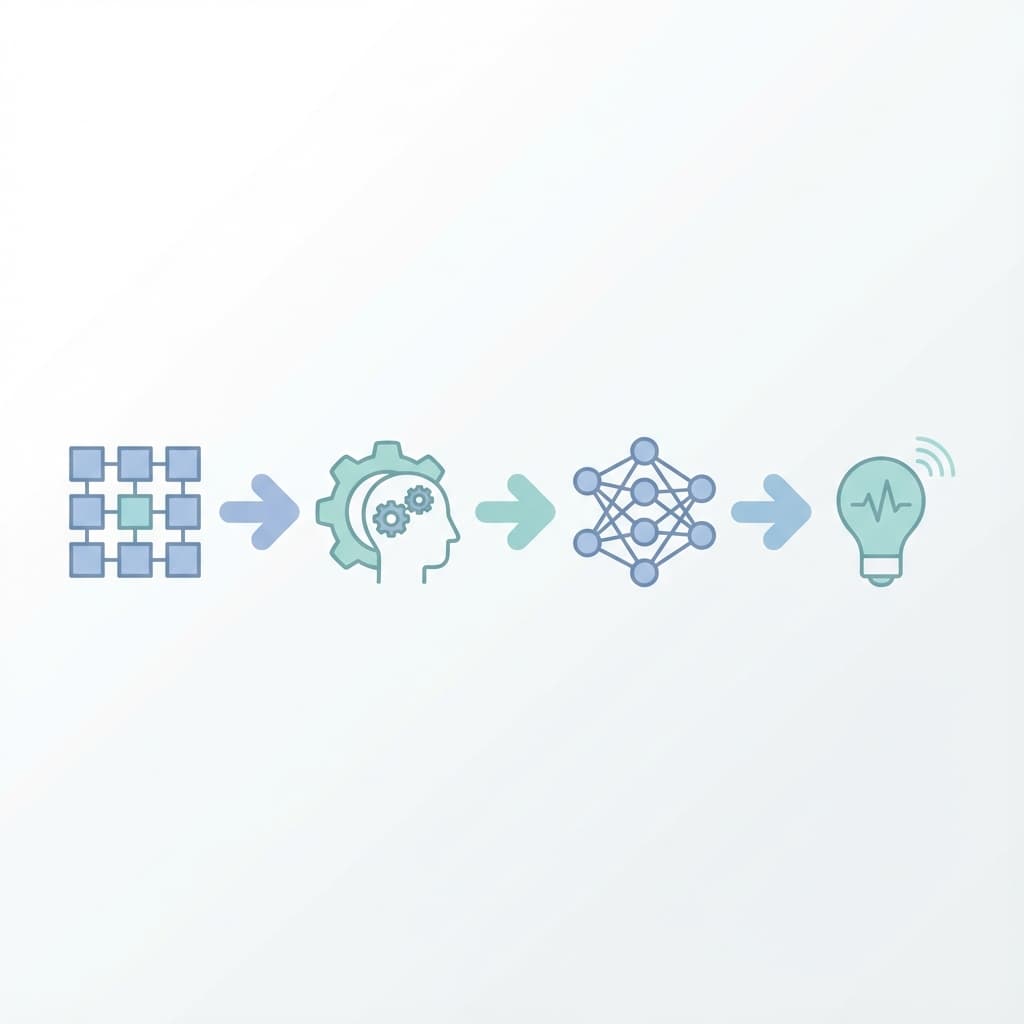
In the last post, we learned what Machine Learning is and what a model does. Now let's see how to actually build one.
Building an ML model has five main steps. Let's walk through each one.
1. Collect Data
Everything starts with data. Without data, there's nothing to learn.
What Kind of Data?
It depends on your goal:
- Want to predict house prices? You need past sales data with prices.
- Want to detect spam emails? You need emails labeled as spam or not spam.
- Want to recognize faces? You need lots of face images.
Where Does Data Come From?
Data can come from many places:
- Your company's database
- Public datasets online
- APIs from other services
- Sensors and devices
- User inputs
The better your data, the better your model. Garbage in, garbage out.
2. Prepare the Data
Raw data is messy. You need to clean it first.
Common Problems
Missing Values
Some rows have empty fields. You can fill them with averages or remove those rows.
Wrong Formats
Dates might be in different formats. Numbers might be stored as text.
Outliers
Some values are way off. A house price of $1 is probably a mistake.
Duplicates
The same record appears twice. Remove the extras.
Feature Engineering
This is where you create new useful columns from existing data.
Example: If you have a date of birth, you can calculate age. Age is often more useful than the raw date.
3. Choose a Model Type
Different problems need different types of models.
For Predicting Numbers
Use Regression models:
- Linear Regression (simple, fast)
- Decision Trees
- Random Forest
- Neural Networks
Example: Predicting house prices, stock prices, or temperatures.
For Classifying Things
Use Classification models:
- Logistic Regression
- Decision Trees
- Random Forest
- Neural Networks
Example: Is this email spam? Will this customer leave? Is this image a cat?
For Grouping Similar Items
Use Clustering models:
- K-Means
- DBSCAN
Example: Group customers by buying habits. Find similar movies.
4. Train the Model
Training is where the learning happens.
What Happens During Training?
- You give the model your prepared data
- The model looks at patterns
- It adjusts itself to match those patterns
- It repeats until it gets good at predicting
Training vs Testing Data
You split your data into two parts:
- Training set (80%) - Used to teach the model
- Testing set (20%) - Used to check if it learned well
Why split? If you test on the same data you trained on, you won't know if it can handle new data.
The Training Loop
For each round:
    1. Model makes predictions
    2. Compare predictions to actual answers
    3. Calculate how wrong it was (loss)
    4. Adjust the model to reduce errors
    5. Repeat
After many rounds, the model gets better and better.
5. Evaluate the Model
How do you know if your model is good?
For Regression (Predicting Numbers)
- Mean Absolute Error (MAE) - Average difference between predicted and actual
- Root Mean Square Error (RMSE) - Penalizes big mistakes more
Example: If predicting house prices, an MAE of $10,000 means predictions are off by $10K on average.
For Classification (Categories)
- Accuracy - What percentage did it get right?
- Precision - Of things it labeled positive, how many were actually positive?
- Recall - Of all actual positives, how many did it find?
Example: A spam filter with 99% accuracy sounds great. But if only 1% of emails are spam, a model that says "nothing is spam" would also be 99% accurate. That's why we check precision and recall too.
The Complete Picture
Here's the full journey:
Raw Data
    ↓
Clean & Prepare
    ↓
Split (Train/Test)
    ↓
Choose Model Type
    ↓
Train on Training Data
    ↓
Evaluate on Test Data
    ↓
If good → Deploy
If not → Adjust and retry
A Simple Example
Let's say you want to predict if a student will pass or fail.
1. Collect Data
Get records of past students: hours studied, attendance, and whether they passed.
2. Prepare Data
Remove students with missing info. Convert "passed" to 1 and "failed" to 0.
3. Choose Model
This is classification (pass/fail), so pick Logistic Regression.
4. Train
Feed the model 80% of your data. Let it learn the patterns.
5. Evaluate
Test on the remaining 20%. See if it predicts correctly.
That's it. You've built a model.
What's Next?
Building a model is just the start. In real life, you face more questions:
- How do you serve this model to users?
- How do you update it when new data comes in?
- How do you monitor if it's still working well?
- How do you version your models?
This is where MLOps comes in. It's the set of practices that handle all these challenges.
Key Takeaways
- Collect Data - Get relevant examples
- Prepare Data - Clean and transform it
- Choose Model - Pick the right type for your problem
- Train - Let the model learn patterns
- Evaluate - Check if it works on new data
Next: MLOps Introduction - What It Is and Why You Need It